These Cycling Desks Charge Your Phone--And Your Muscles--While You Work
Get link
Facebook
X
Pinterest
Email
Other Apps
By
Bill
-
At the office or airport, 30 minutes of easy pedaling on a WeBike will get you a full iPhone charge and keep you fit.
If you need to charge your phone while you're waiting for a flight at Schiphol Airport in Amsterdam, or while sitting at the train station in Lyon, you can get a little exercise at the same time. The waiting areas are filled with WeBikes, stationary bikes that power gadgets and a Wi-Fi connection as you pedal.
It takes about 30 minutes of easy pedaling to charge an iPhone, the same amount of time it would take while plugged into the wall. "It also happens to be the same number of minutes of exercise that the government prescribes for health," says Katarina Verhaegen, the engineer who developed the bike.
The bike was the brainchild of a Flemish government minister, Patricia Ceysens, who was working long hours and couldn't find time to work out. She hacked together a cycling desk for herself, and then realized that the bikes could also be used to generate power. As more people asked her for a version of her desk, she eventually decided to start a company, WeWatt, to produce them.
At the moment, the WeBikes are mostly used in public spaces, such as libraries and hotels, but the company hopes to bring them to more offices. "In the public domain, the focus has been on green energy," Verhaegen says. "People like power while they're on the move. But in the office, the focus will be more on the health side--the green energy stuffwill be used more as a motivational aspect to get people started on the habit of riding at work."
Riding a bike while working--though it might sound distracting--can actually help improve the quality of work. "People don't believe they can do two things at the same time," says Verhaegen. "But there are studies proving that gentle exercise while doing computer work, you're more focused and more creative. Reading and memorizing speed is enhanced. For productivity, and creativity, it's really good to do this."
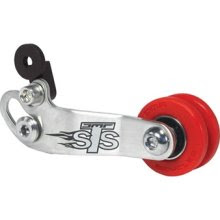
The simple tension seeker (STS) by DMR Bikes should not really be called a chain tensioner , but rather a slack-remover. It's an incredibly simple solution for those looking to convert a bike with vertical dropouts for single speed use. DMR is a UK-based company that specializes in downhill, freeride, and dirt jump chain devices, and the STS reflects this design experience in this burly device. Installation is a 5-minute job (assuming you have already replaced your cassette with a cog, and shortened your chain as much as possible). Simply remove the skewer nut and slide the black aluminum mounting bracket onto the dropout. Then loosely bolt the stainless steel arm to the bracket and the derailleur hanger with two 5mm bolts. Replace the skewer nut. Rotate the cranks until the chain is at its tightest. (Very few chainrings and cogs are perfectly round.) Lift up on the arm so that the red pulley pushes the chain upward, removing the slack, and tighten the two 5mm bolts. That...
Nearly 30 years ago, J. David Rhoades had a unique idea – to design and market a 4-wheel bicycle that everyone could enjoy. He appropriately named it the Rhoades Car... http://www.rhoadescar.com/rcar/index.shtml




Comments
Post a Comment